Sephora Virtual Artist Case Study: How AR Makeup Try-On Changed Online Beauty Shopping sephora-virtual-artist-ar-makeup-try-on-case-study
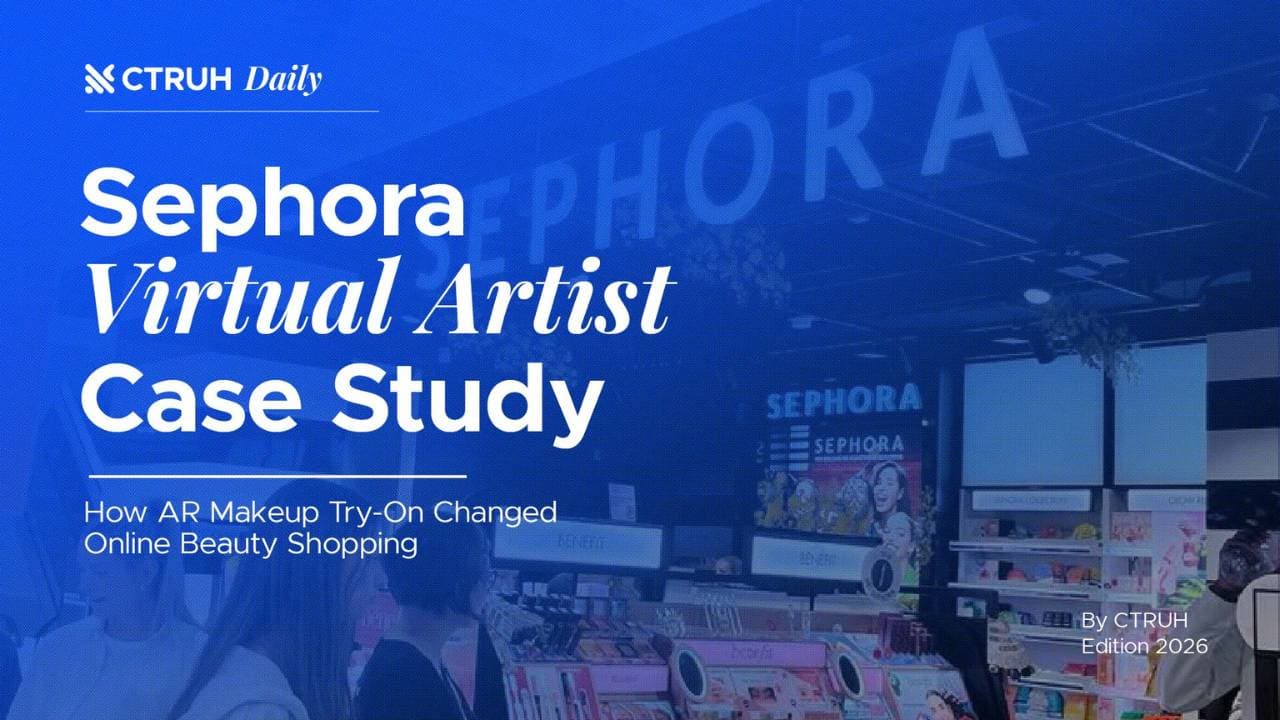
Wrong shade. Wrong undertone. $40 wasted. For decades, that risk kept beauty shoppers in stores. The Sephora Virtual Artist AR try-on changed what was possible online and set the standard every beauty brand has followed since.
What is Sephora Virtual Artist?
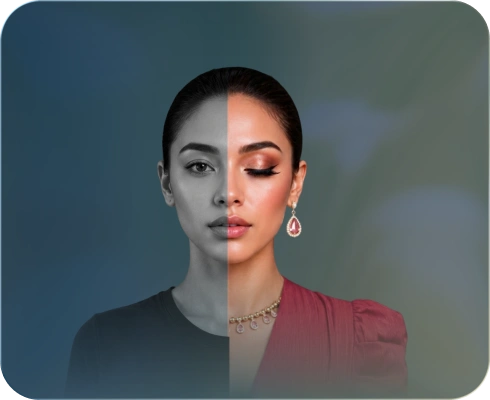
Sephora Virtual Artist is an AR feature in Sephora's mobile app that uses facial recognition to let customers try on lipstick, eyeshadow, and foundation shades in real time through their phone camera without entering a store or touching the product. It launched in 2016, built with AR beauty technology partner ModiFace.
How many people used Sephora's AR makeup try-on?
By 2018, Sephora reported over 200 million shade combinations tried and 8.5 million visits to the Virtual Artist feature since launch. These figures come directly from Sephora VP of Innovation Bridget Dolan in company statements.
Why did Sephora build an AR try-on app?
Sephora built Virtual Artist to solve the core barrier preventing beauty shoppers from buying confidently online: not knowing how a shade would look on their specific skin tone. AR eliminates that uncertainty before purchase, reducing the hesitation that kept beauty shopping tethered to physical stores.
200M+
Shade combinations tried by 2018
8.5M
Visits to the Virtual Artist feature
2016
Launch year. One of first beauty AR apps
The short version
- Sephora launched Virtual Artist in 2016: An AR app built with ModiFace that lets customers try on makeup shades in real time, without a store visit.
- Within two years, Sephora reported over 200 million shade combinations tried and 8.5 million visits to the feature.
- L'Oréal acquired ModiFace in 2018, deploying the same AR technology across Maybelline, Garnier, NYX, and others, validating Sephora's early bet at industry scale.
- A data note: Some widely circulated figures (including revenue attribution percentages) cannot be traced to primary Sephora sources and are not included here. Everything in this article is source-verified.
In this article
- The costly beauty mistake that online shopping couldn't prevent
- How Sephora Virtual Artist AR makeup try-on actually works
- Sephora Virtual Artist results: what the verified data shows
- Why Sephora's augmented reality beauty app succeeded where others failed
- How Sephora's AR try-on became the beauty industry blueprint
- The insight behind virtual beauty try-on that applies beyond cosmetics
- Frequently asked questions
The Costly Beauty Mistake That Online Shopping Has Always Struggled to Prevent
Lipstick looks one way under fluorescent store lighting. A different way in the product photograph. A third way on your specific lips, in your natural light. These aren't subtle variations. They're the difference between a shade that works and $40 you quietly write off and never use.
This is why beauty has historically been the category most resistant to moving online. Not because of price. Not because of shipping. Because the purchase decision is deeply personal and deeply visual and a flat image on a screen has never been able to answer the question every beauty shopper needs answered before buying: how does this look on me?
The consequence is measurable. Beauty shoppers who couldn't answer that question with confidence either drove to a physical store, or didn't buy at all. For online beauty retailers, this translated directly into hesitation, cart abandonment, and return rates that reflected a simple failure of confidence rather than dissatisfaction with the product itself.
Sephora didn't set out to build a technology showcase. They set out to eliminate a specific, expensive mistake buying the wrong shade and close the trust gap that had always kept beauty shoppers offline.
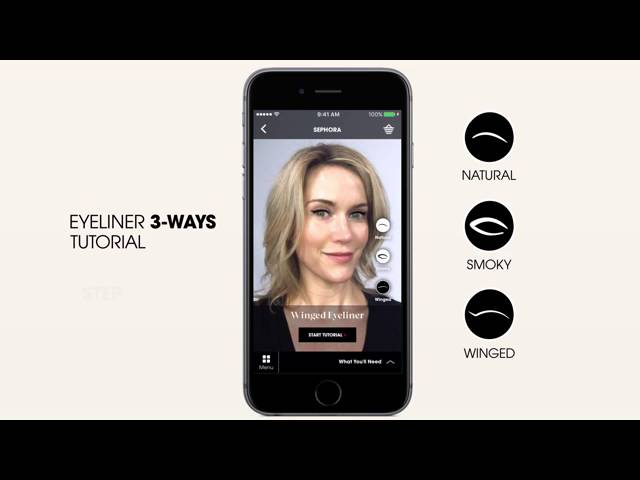
How the Sephora Virtual Artist AR Makeup Try-On App Works
Sephora began experimenting with AR in partnership with ModiFace, a Canadian company founded by University of Toronto professor Parham Aarabi as early as 2015. Initial trials used in-store tablets and large-format AR mirrors. By 2016, the technology had reached a fidelity level Sephora judged sufficient for commerce, not just demonstration: accurate enough to show real colour rendering across different skin tones, in realistic lighting, with believable material texture.
Virtual Artist launched in 2016 as a feature within Sephora's existing mobile app. Critically, it required nothing new from the customer. No separate download, no additional account, no hardware. The app they already had became the try-on tool.
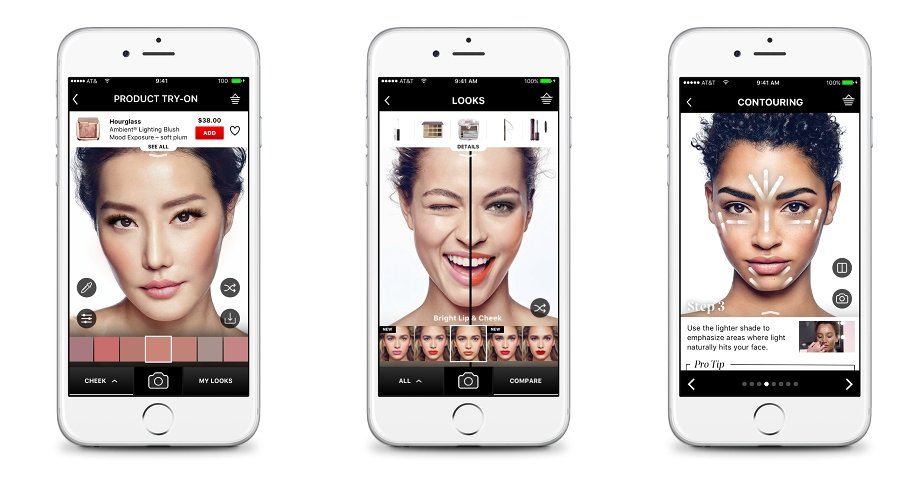
How Sephora Virtual Artist AR try-on works — step by step
- Face detection: The app activates the front camera and uses facial recognition to map the user's face identifying lip boundaries, eye contours, and brow shape with precision sufficient to anchor virtual products accurately
- Product selection: Users browse Sephora's catalogue of lipsticks, eyeshadows, blushes, and foundations within the app and select any shade
- Real-time AR overlay: The selected shade is applied to the user's live face in real time lipstick to the precise lip contour, eyeshadow to the eyelid — with lighting-adjusted colour rendering
- Comparison and iteration: Users switch between shades instantly with a tap, compare looks side by side, and save combinations for reference or sharing
- Direct-to-purchase: Any product tried on links directly to Sephora's shopping cart closing the gap between discovery and transaction in a single session
The tool expanded in phases. Lip colours were first. Eyeshadow palettes followed, then blush, then contouring, then foundation matching powered by AI skin analysis. By 2018, over 20,000 products were available in the virtual try-on system.
"Since launching Sephora Virtual Artist in 2016, our clients have virtually tried on hundreds of millions of shade combinations. It gives her the freedom to choose when, where and how she wants to shop."
— Bridget Dolan, VP of Innovation, Sephora (2017)
This wasn't position-taking about the future of beauty. This was a direct commercial observation: when you give beauty shoppers the ability to answer their own question "how does this look on me?". They use it, at scale.
Sephora Virtual Artist Case Study Results: What the Verified Data Actually Shows
A note on data integrity before this table: some figures widely cited in connection with this case study cannot be traced to primary statements from Sephora. Where a metric comes from a secondary or attributed source, that is noted. Where data is unverified, it is excluded.
| Metric | Result | Source & Credibility | |
| Total shade combinations tried | 200M+ | Bridget Dolan, VP Innovation, Sephora — primary company statement (2017–2018) | Highest-confidence figure in this dataset |
| Feature visits since launch | 8.5M | Sephora company data — confirmed across multiple press sources | Reflects visits to the feature, not total users |
| Products in Virtual Artist (2018) | 20,000+ | Sephora / ModiFace official statements | |
| Launch date | 2016 (lip colours); expanded to eyes, skin 2017–2018 | Sephora Global Newsroom | |
| Technology partner | ModiFace (acquired by L'Oréal, 2018) | L'Oréal official announcement — primary source | |
| App session length change | Reported increase from avg 3 min to 12 min | DigitalDefynd research — secondary source, not primary Sephora data | Treat as directional, not confirmed |
| Purchase likelihood for try-on users | Reported 3x higher than non-users | Secondary reporting — not confirmed in primary Sephora disclosures | Directional signal; Sephora has not published this figure officially |
On the "40% of revenue" claim you may have encountered:
Multiple articles attribute 40% of Sephora's online revenue to Virtual Artist. This figure has never appeared in a primary Sephora statement, earnings disclosure, or investor communication we can identify. The 40% figure in circulation traces to a general Deloitte study on AR conversion rates applied to Sephora without attribution from Sephora itself. We have excluded it from this analysis. The 200 million shade tries and 8.5 million visits are the figures Sephora's own executives have stated directly.
What the verified data does establish is genuine at-scale engagement: 200 million voluntary interactions with a product visualization tool, across a customer base that could have simply looked at the same product photographs that had always existed. Customers chose the AR experience over the alternative. That revealed preference is commercially meaningful regardless of the specific conversion lift it generated.
Why Sephora's AR Makeup Try-On App Succeeded Where Other Digital Beauty Experiments Didn't
The beauty category had attempted to move online multiple times before Virtual Artist. Product photography improved. Video tutorials proliferated. Shade finder quizzes multiplied. None of them solved the core problem, because none of them could answer the foundational question with visual specificity: how does this look on my face?
Three reasons Sephora Virtual Artist AR try-on succeeded
- It solved the right problem, not just a visible one. The barrier to buying beauty online wasn't navigation, pricing, or shipping. It was uncertainty about how the product would appear on one specific face — the buyer's. Virtual Artist answered that question with real-time accuracy, in the buyer's own lighting, on their own face. Every previous digital beauty tool answered a different question.
- It required no behavior change from the customer. Virtual Artist launched inside Sephora's existing app. No new download, no new login, no new device. Sephora met customers where they already were, on software they already used. The friction of adoption was reduced to a single tap within an app already installed on the customer's phone.
- It connected directly to the purchase. Virtual Artist wasn't a standalone experience or a marketing campaign. It was integrated into Sephora's commerce platform. A customer who tried on a shade and liked it could add it to their cart without leaving the experience. Discovery and transaction happened in the same session.
The experience that converts is not the most impressive one. It's the one that removes the specific doubt preventing the purchase at the exact moment that doubt exists.
How Sephora Virtual Artist Became the AR Beauty Shopping Blueprint
L'Oréal's acquisition of ModiFace in 2018 is the data point that most clearly signals how the industry read Sephora's experiment. L'Oréal, the world's largest beauty company paid for the technology that powered Virtual Artist and immediately deployed it across its portfolio: Maybelline, Garnier, NYX, Essie, L'Oréal Paris, and others. The same AR try-on that appeared in Sephora's app in 2016 was powering AR try-on on Amazon's beauty section by 2019.
Ulta Beauty launched its own AR try-on tool (GlamLab). MAC and Charlotte Tilbury built similar features. The experiential template Sephora created real-time face-anchored AR, shade comparison, direct-to-cart integration is the template every beauty brand's digital try-on now follows.
The standard Sephora's AR set for the beauty industry:
Virtual Artist established a baseline expectation: virtual beauty try-on should be real-time, face-accurate, colour-calibrated, and purchase-connected. Any subsequent AR beauty tool that fell below that standard faced the same user skepticism as a blurry product photo. Sephora defined what AR beauty try-on needed to be to be taken seriously and the entire industry has been building to that standard since.
The Insight Behind AR Beauty Try-On That Applies to Every Product Category
Strip away the lipstick. The principle Sephora proved is not limited to cosmetics.Every product category has a version of the beauty industry's shade problem. A specific, visual, personal uncertainty that cannot be resolved by reading a description or looking at a product photograph. In furniture, it's: will this look right in my room? In jewellery, it's: how does this look on my hand? In fashion, it's: does this fit and work with what I own? In automotive, it's: what does this interior actually look like from the driver's seat?
In each case, the purchase anxiety is real, the return consequence is expensive, and the traditional digital commerce tools, images, dimensions, reviews cannot fully resolve the doubt that causes hesitation. What can resolve it is letting the customer see the product in their own context, with their own face, in their own room, before they commit.
That is what Sephora built in 2016 for the beauty category. The technology for building it across jewellery, fashion, and home products now exists in a browser-native format, no app download, no specialized hardware, no friction. That layer of the commerce experience is the precise problem CTRUH is built to solve: reducing the uncertainty that sits between a customer who is interested and a customer who is confident enough to buy.
If you've read this far
What is the specific doubt preventing your customer from buying? Can a better visual experience remove it?
That is the question Sephora answered in 2016 for beauty. It isn't unique to cosmetics, it exists in jewellery, fashion, furniture, and every product where customers need to see the item in their own context before they trust it enough to commit. CTRUH builds browser-based virtual try-ons and 3D commerce tools for exactly this problem.
Related case studies
IKEA Place AR App: 98% accuracy, 8M downloads — and the furniture return problem it solved →
Gucci on Roblox: 20M visitors, a $5.50 bag that sold for $4,115 — the full story →
Frequently Asked Questions About Sephora Virtual Artist and AR Makeup Try-On
What is Sephora Virtual Artist and how does AR makeup try-on work?
Sephora Virtual Artist is an AR feature in Sephora's mobile app. It uses facial recognition to map the user's face in real time, then overlays virtual makeup products: lipstick shades, eyeshadows, blush with accurate colour rendering. Users can switch shades instantly, save looks, and purchase directly within the same session. It launched in 2016 in partnership with AR technology company ModiFace.
How many people have used Sephora's Virtual Artist AR try-on?
By 2018, Sephora reported over 200 million shade combinations tried and 8.5 million visits to the Virtual Artist feature. These figures were stated directly by Sephora VP of Innovation Bridget Dolan and are the most credible primary-source data available for this case study.
Did Sephora Virtual Artist increase makeup sales and conversions?
Sephora has not publicly disclosed specific conversion rate figures. Secondary research reports suggest users of Virtual Artist were significantly more likely to complete a purchase than non-users, and that app session times increased among feature users. However, these are secondary-source claims and should be treated as directional rather than confirmed primary data from Sephora.
Who built the AR technology behind Sephora Virtual Artist?
ModiFace, a Canadian AR beauty company founded by University of Toronto professor Parham Aarabi. L'Oréal acquired ModiFace in 2018, and the technology now powers AR try-on across L'Oréal's portfolio including Maybelline, Garnier, NYX, and L'Oréal Paris as well as on third-party platforms including Amazon's beauty section.
Which beauty brands use AR virtual try-on after Sephora?
Ulta Beauty (GlamLab), MAC Cosmetics, Charlotte Tilbury, L'Oréal (across multiple brands via ModiFace), Maybelline, and NYX have all launched AR virtual makeup try-on experiences. Sephora's 2016 launch established the commercial viability and the baseline standard for what AR beauty try-on needs to deliver to be useful.
Sources
- Sephora PR — Virtual Artist lip try-on launch announcement (2016); Virtual Artist eyeshadow expansion (Mar 2017)
- Bridget Dolan, VP Innovation, Sephora — direct quotes in company press materials (2017): 200M shade combinations tried, 8.5M feature visits
- TechRepublic — "How Sephora is leveraging AR and AI to transform retail" (Feb 2018)
- Trackmind — "Sephora: Augmented Reality, Artificial Intelligence & Future of Beauty" — 8.5M visits confirmation
- L'Oréal — Official ModiFace acquisition announcement (Mar 2018)
- Digiday — "Makeup brands are testing augmented reality to drive conversions" (2016) — ModiFace CEO Parham Aarabi quotes
- BrandXR — "2025 Augmented Reality in Retail and E-Commerce Research Report" — industry context